What Growing Businesses Learn When Microsoft Security Comes Before AI
Most growing businesses do not have an AI problem. They have an AI readiness problem.
Employees are already using AI to find information, analyze data, automate work, and make faster decisions. Microsoft 365 Copilot and the first wave of AI agents are extending those capabilities into the Microsoft environments these organizations already run on.
The tools are not the hard part. The hard part is knowing what happens when AI is pointed at years of accumulated business data, and whether the answer is one leadership can live with.
That is a security question before it is an AI question.
The Real Reason AI Projects Stall
Plenty of AI initiatives die quietly. Not because the technology failed, but because no one could answer a simple question from finance, legal, or the board: what will this thing actually be able to see?
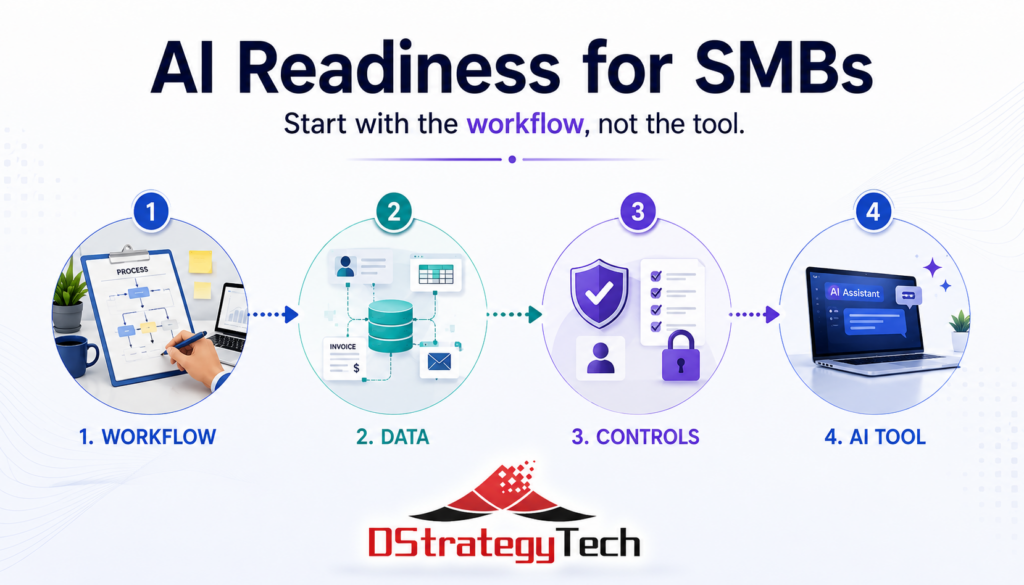
It is a fair question, and it stops projects. The organizations that clear it quickly are rarely the ones with the biggest security budget. They are the ones who did a specific piece of work in a specific order beforehand, so the approval conversation shifts from proving something is safe to demonstrating it is already controlled.
The order matters more than most people expect.
Information Behaves Differently Once AI Can Reach It
AI makes organizational information dramatically more useful. Employees surface knowledge faster, analyze across sources, and summarize complex material in seconds.
That same capability makes years of accumulated permissions, legacy collaboration sites, and quietly connected applications visible in ways they never were before. What an assistant can reach on day one was decided long ago, by decisions no one remembers making.
There is a meaningful difference between environments where this is discovered before deployment and environments where it is discovered after. The gap is usually not technical sophistication. It is sequence.
Most of the Foundation Is Already Paid For
For organizations already in the Microsoft ecosystem, much of the security foundation is already licensed and available.
Entra, Defender, Intune, Purview, and Sentinel span identity, data, devices, applications, threat protection, governance, and security operations. Growing organizations often have capabilities available to them that are not fully configured or utilized.
Which pieces to activate, and in what sequence, is where the actual expertise lives. Turning everything on at once creates noise, friction, and a help desk problem. Turning on the right things in the right order tends to produce more measurable risk reduction than the next product purchase would.
Visibility Changes How Money Gets Spent
Without a clear picture of the environment, security spending becomes reactive. Every headline, vendor pitch, and client security questionnaire creates pressure to buy something.
With that picture, leaders can rank exposures against real business impact and fund the ones that matter. The conversation stops being about threats in the abstract and starts being about this organization, this data, these users.
That shift is usually worth more than any single control.
What Comes After Copilot
The next phase of AI extends well past assistants. Agents will act on information, applications, and workflows on behalf of the business.
That raises the stakes on visibility, accountability, and governance considerably. The organizations positioned to move quickly on agents will be the ones that sorted out identity and data controls during the Copilot phase, largely because the groundwork does not need to be laid twice.
The window to do that work quietly, before it becomes urgent, is open right now.
Where This Starts
Confident AI adoption starts with understanding the Microsoft environment AI will inherit.
The DStrategyTech Microsoft 365 + AI Security Assessment gives business and technology leaders a clear view of their current security posture, priority areas of risk, and a practical path toward secure AI adoption.
The outcome isn’t more security technology. It’s the confidence to move forward with AI.