What We Do

DStrategyTech is a Michigan-based Microsoft Partner founded by a Microsoft MVP, helping small and mid-sized businesses streamline operations, unify data, and automate workflows.

Dynamics 365 ERP | Business Central

As businesses grow, finance and operations often become harder to manage. Data sits in different places, reporting takes longer, and teams rely on workarounds outside the system.

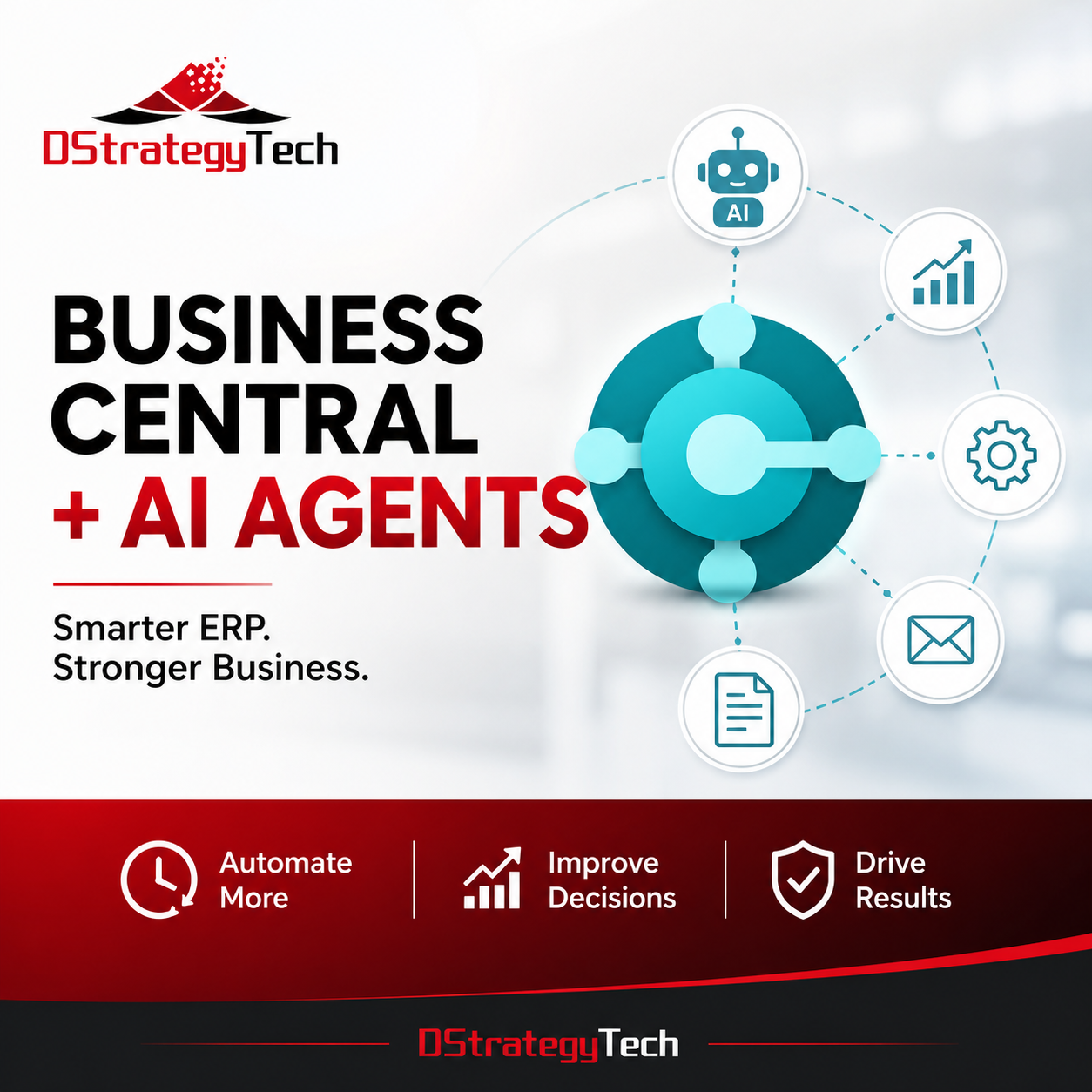
Microsoft Business Central brings structure back to your operations by connecting financials, processes, and reporting in one place.
From implementation to ongoing support, the focus is on better financial control, real time visibility, and more confident decision making.

Power Platform

Manual processes, disconnected systems, and spreadsheet based tracking slow teams down over time.

Microsoft Power Platform helps connect your ERP and CRM data, automate workflows, and reduce repetitive work across the business.

Using Power Apps, Power Automate, and Power BI, teams can operate with automated processes, consistent data, and real time visibility.

Latest Insights

Business Central, AI and Operational Intelligence

Manufacturing Analytics in Business Central

Manufacturing teams using Microsoft Dynamics 365 Business Central have access to production and cost data, but many still struggle to turn it into reliable financial insight.

The issue is not data availability. It is how that data is validated and applied during operations.


1. Cost Variances Are Identified Too Late

In many environments, production cost differences are only reviewed after completion.

  • expected vs actual costs are not monitored during production
  • material and labor variances are identified late

This delays corrective action and directly impacts financial accuracy.


2. Capacity and Production Data Are Underutilized

Work center and production data exist, but are not consistently used.

  • underutilized and overburdened resources go unnoticed
  • planning decisions rely on incomplete visibility

Without active monitoring, efficiency opportunities are missed.


3. Financial Reporting Depends on Manual Validation

Even with integrated systems, teams still rely on manual checks.

  • data is exported to Excel for validation
  • inconsistencies are corrected outside the system

This slows reporting and reduces confidence in financial outputs.


🔹 Conclusion

Manufacturing analytics in Business Central provides the necessary data.

The challenge is ensuring that production data is:

  • accurate
  • consistent
  • aligned with financial outcomes

As automation increases, this becomes critical to maintaining trust in financial reporting and operational decisions.


🔹 Get in Touch

If you are using Business Central in a manufacturing environment and want to improve the accuracy and reliability of your production and financial data, connect with us:

Business Central Validation and Control
Business Central in the AI Era: Why Validation and Control Are Becoming Critical

As organizations adopt automation and begin introducing AI into their operations, systems like Microsoft Dynamics 365 Business Central are changing.

They are no longer just systems where users enter data through screens.
They are becoming systems where transactions, workflows, and decisions are executed automatically.

This shift introduces a new challenge.

How do you ensure the system is doing the right thing consistently and at scale


The Reality for Most Business Central Customers

For many small and mid-sized businesses, the focus has been on implementation and adoption.

But as usage grows, a different set of problems starts to appear:

  • Financial data does not always reconcile cleanly
  • Teams rely on Excel to validate reports
  • Posting errors go unnoticed until month end
  • Integrations do not always stay in sync
  • Automation runs without visibility or validation
  • Changes in sandbox do not always behave the same in production
  • Audit preparation becomes reactive and time consuming

These are not isolated issues.
They point to a deeper problem.

A lack of continuous validation and control across the system


Four Areas Where the Gaps Show Up

1. Data Integrity: Can You Trust Your Numbers

Financial data is expected to be the single source of truth.

In reality:

  • General ledger and subledgers do not always align
  • External systems introduce mismatches
  • Teams manually reconcile data outside the system

When this happens, confidence in reporting drops.


2. Transaction Control: Are Entries Being Posted Correctly

Most errors do not come from system failures.
They come from small inconsistencies:

  • Incorrect dimensions
  • Wrong accounts
  • Duplicate or incomplete entries

Without proper validation, these errors compound over time.


3. Automation and Integration: Is the System Doing the Right Thing

As workflows and integrations increase:

  • Processes run without direct human review
  • Data flows between systems continuously
  • Issues are harder to detect in real time

Automation improves speed, but without validation, it also increases risk.


4. Change and Governance: Can You Safely Evolve the System

Every system change introduces uncertainty:

  • Configuration updates behave differently in production
  • Testing is often partial or inconsistent
  • Audit readiness depends on manual effort

As the system grows, so does the need for structured control.


Why This Matters Now

Historically, errors were caught because people were involved at every step.

That is no longer the case.

As Business Central environments become more automated, fewer transactions are manually reviewed.
This makes proactive validation and control essential.

Without it:

  • Errors spread faster
  • Financial data becomes less reliable
  • Decisions are made on inconsistent information

The Emerging Need

There is a growing need for a layer that sits on top of Business Central and answers three simple questions:

  • Is the data correct
  • Are transactions behaving as expected
  • Are automated processes producing the right outcomes

This is not traditional testing.
It is continuous validation.


A Practical Starting Point

For most organizations, the first step is simple.

It starts with:

  • identifying inconsistencies
  • validating key financial relationships
  • introducing visibility into automation

From there, control can be gradually introduced.