Cybersecurity and Data Audit: Protecting the Data AI Can Reach
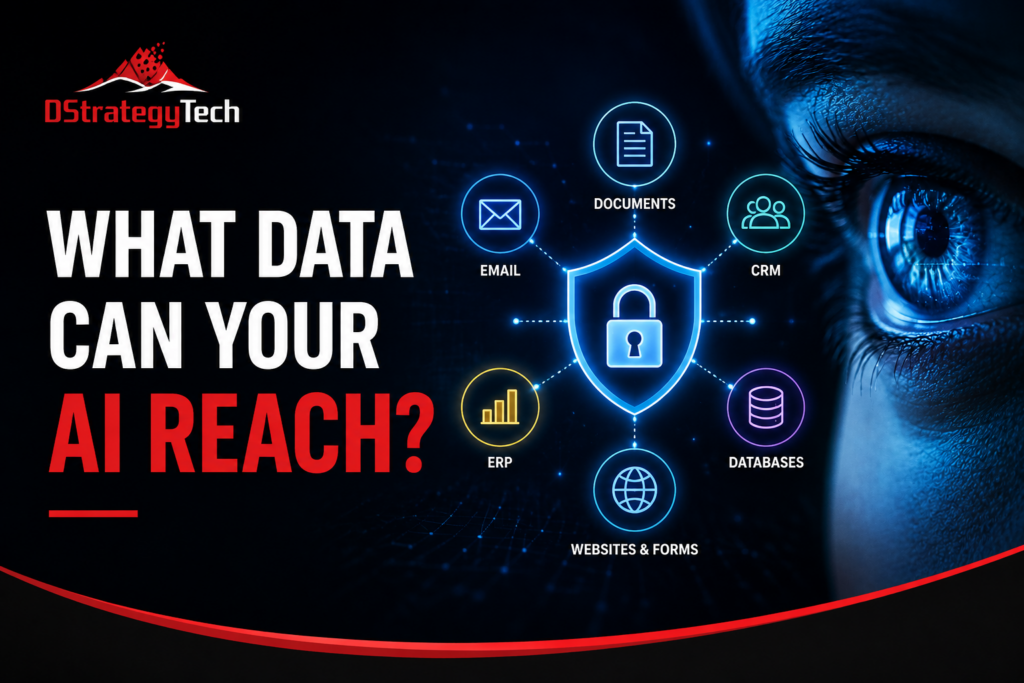
AI adoption is changing a fundamental cybersecurity question. It is no longer enough to ask who can access your business data. Organizations also need to ask:
What data can our AI tools reach?
For small and mid-sized businesses, that data may be spread across Microsoft 365, Dynamics 365, ERP and CRM platforms, websites, databases, cloud storage, email, documents, and third-party applications.
As AI becomes connected to these systems, understanding its reach should become part of the organization’s cybersecurity and data audit.
Start With the Data, Not the AI Tool
Before evaluating AI security, identify where important business data resides.
For a Microsoft-centered organization, this could include:
- Microsoft 365: Outlook email, Teams conversations, SharePoint sites and OneDrive files
- Dynamics 365 CRM: customers, contacts, opportunities, activities and sales history
- ERP systems: financial records, vendors, purchasing, inventory, orders and employee-related information
- Websites: contact forms, customer inquiries, analytics and uploaded information
- Databases and data platforms: SQL databases, Microsoft Fabric, Power BI datasets and data warehouses
- Other SaaS applications: ticketing, HR, marketing, accounting and industry-specific platforms
The objective is not simply to create another inventory. It is to understand which systems contain sensitive or business-critical information and how AI could interact with them.
One distinction matters here. Data held in an on-premises ERP environment, such as Dynamics NAV or AX, may sit outside the organization’s primary Microsoft 365 governance boundary. Before exposing that data to AI, organizations should understand how identity, classification, access controls and monitoring extend to those systems.
Map What AI Can Reach
An AI assistant may appear to be a simple chat interface while operating through connectors, APIs, plugins, agents, identities and user permissions.
For example, an AI system connected to Microsoft 365 could potentially retrieve documents from SharePoint or OneDrive. An agent connected to Dynamics 365 could interact with customer records. An AI workflow connected to an ERP system could potentially process financial or operational information.
That creates an important audit question:
Does the AI have access only to the information required for its business purpose, or can it reach significantly more?
Organizations should map each AI tool or agent to the systems, identities, connectors and data sources it can access.
Identity, Permissions, Data, AI Access
AI can amplify weaknesses that already exist.
A SharePoint site with overly broad permissions, an old user account with unnecessary access, or an ERP integration using excessive privileges may become more significant when AI can discover and process information across systems quickly.
A cybersecurity and data audit should therefore follow that sequence in order: identity, then permissions, then data, then AI access. Each layer determines what the next one can reach.
Look for excessive privileges, stale accounts, unnecessary connectors, public links, sensitive information in inappropriate locations, and AI applications with broader access than their purpose requires.
Protect, Monitor and Reassess
The audit should not end when an AI application is deployed.
Organizations should monitor authentication, connector activity, unusual data access, permission changes and sensitive-data interactions. Existing capabilities such as Microsoft Entra ID, Purview, Defender, audit logs and data-loss-prevention controls can contribute to that visibility.
The environment should also be reassessed when a new AI agent, connector, data source or business process is introduced.
The Bottom Line
AI does not eliminate traditional cybersecurity and data-governance principles. It makes understanding data access more important.
For small and mid-sized businesses, the starting point can be straightforward: know where your important data lives, understand what your AI can reach, restrict access to what it actually needs, and monitor that access over time.
The reach your AI tools have today is determined by the identities, permissions, connectors and systems behind them. Understanding that reach is where the work begins.
Next Step
A cybersecurity and data assessment identifies where sensitive information resides across your systems, what your current AI tools and connectors can access, and which controls to establish before AI usage expands further.
Contact DStrategyTech to discuss your environment.
Related Posts