Zoho to Dynamics 365 migration – 4 decisions that determine cost

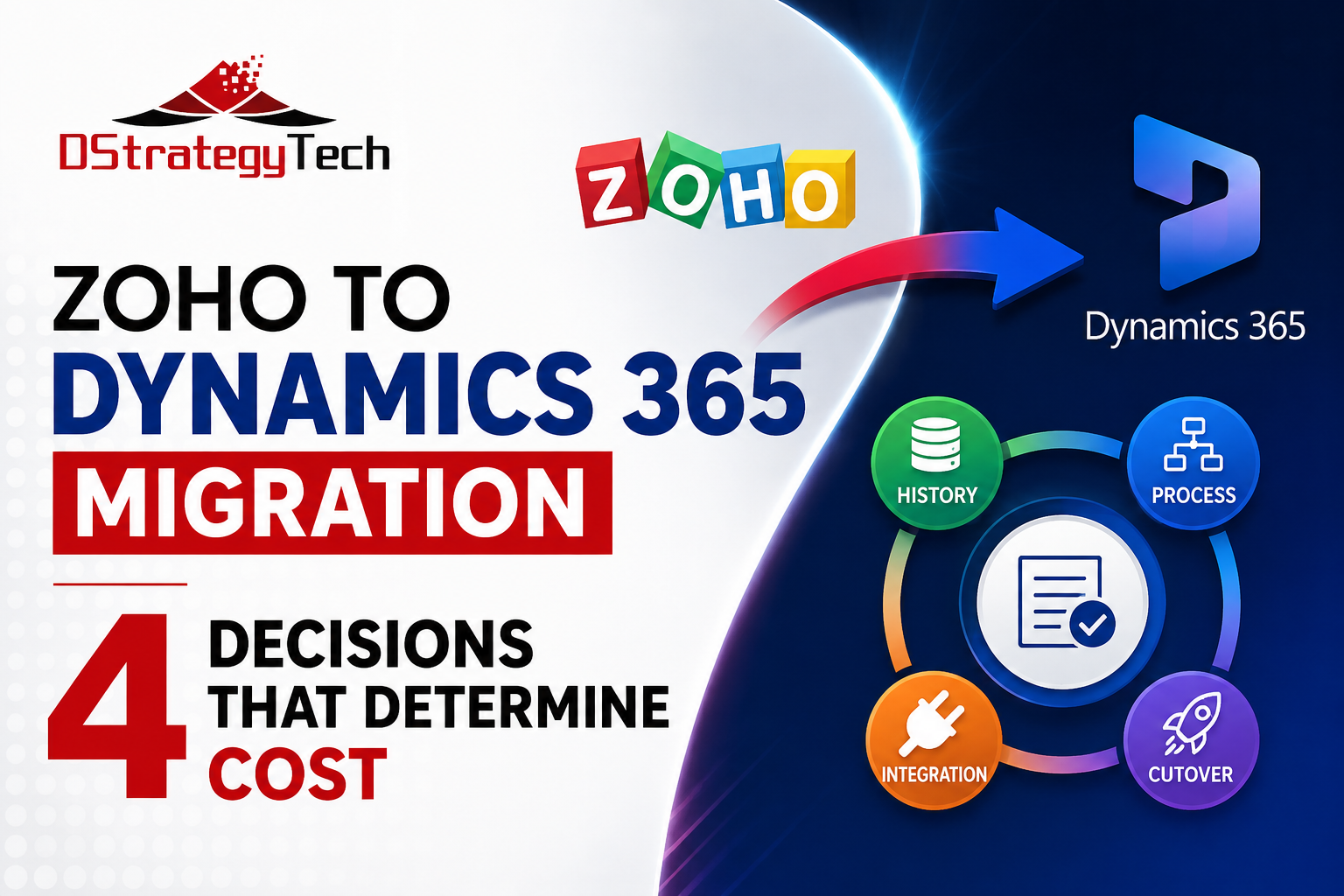
Zoho to Dynamics 365 Migration: The 4 Decisions That Determine Cost

Most CRM migrations do not fail on the platform. They fail on assumptions made before anyone signed — about how much history would come across, how closely the new system would resemble the old one, and how much of the sales process was actually written down anywhere.

By the time a company is seriously evaluating a move from Zoho to Dynamics 365, the platform decision is usually the easy part. The hard part is that a CRM is not a database. It is a database plus a decade of accumulated custom fields, workflow rules, half-abandoned modules, duplicate accounts, and one salesperson’s private naming convention that three reports now depend on. All of that has to be sorted before it moves, or it moves anyway and becomes someone else’s problem in the new system.

Why Companies Actually Leave Zoho

Buyers usually describe the reason as “Zoho is limiting us.” That is rarely the whole story, and the real trigger matters because it determines what a successful migration has to accomplish.

Microsoft is already the rest of the stack. The company runs Microsoft 365, and the CRM is the only significant system living outside it. Every meeting note, quote, and forecast requires a context switch, and single sign-on, security policy, and data protection all have an exception carved out for one application.

The ERP integration keeps breaking. Sales creates a customer in one system, finance creates the same customer in another, and someone reconciles the two by hand. For mid-sized companies this is often the clearest financial argument for the move, because the cost of the workaround is measurable in hours.

Leadership stopped trusting the numbers. Pipeline reported from CRM does not match what the sales leader believes, so the sales leader keeps a spreadsheet. Once that spreadsheet exists, the CRM has already lost.

Scale caught up with the configuration. What worked at eight users and one product line does not work at forty users, three divisions, and a channel partner network.

Each of these implies a different definition of success. A company leaving because of ERP integration pain will judge the project on whether customer and order data flow correctly. A company leaving because leadership lost trust in the numbers will judge it on whether the forecast is finally believable. Building the wrong one well is still a failed project.

The Four Decisions

There is no single correct migration pattern, and this is where projects get expensive by choosing badly — usually by not choosing at all and letting the default happen.

1. How much history comes across. The instinct is to bring everything. Every closed deal, every note, every email logged since 2016. It is worth interrogating. Open pipeline, active accounts, and current contacts are non-negotiable. Closed opportunity history has real value for forecasting and account planning, but it also carries the highest data quality cost, because it is the least maintained data in the system. Attachments, logged emails, and notes are where migration timelines quietly double.

A defensible middle path is common: full migration of active records and relationships, a defined window of closed history, and an archive of the remainder kept accessible but out of the production system. The decision should be made deliberately, priced accordingly, and not discovered halfway through the project.

2. Replicate the process, or redesign it. Zoho concepts do not map one-to-one onto Dynamics. Modules become Dataverse tables. Deals become opportunities, with stages that may or may not survive contact with a real sales process. Blueprints become business process flows. Workflow rules become a mix of Power Automate flows and business rules, and rarely map one to one.

The temptation is to rebuild Zoho inside Dynamics as closely as possible, on the theory that it minimizes disruption. It does minimize disruption. It also means paying migration cost to preserve the constraints that prompted the move. The opposite failure is redesigning the entire sales process at the same time as changing platforms, which produces a project that slips and a sales team that resists both changes at once.

The workable version is narrow: keep the process the team actually follows, fix the two or three things everyone already complains about, and defer the rest to an optimization phase after go-live.

3. What the CRM connects to. For most companies making this move, CRM in isolation is not the point. The value shows up when the customer record in Dynamics and the customer record in the ERP are the same customer — when sales can see credit status, open orders, and payment history without asking finance.

The pattern depends on the ERP. Organizations already running Dynamics 365 Business Central have a shorter path, since both systems sit inside the same Dynamics 365 and Dataverse ecosystem. Dynamics GP and Sage environments need an integration layer, and the design of that layer is a genuine architectural decision rather than a configuration step. This is worth scoping at the same time as the CRM migration, even if it is delivered afterward, because the data model decisions made during migration will either enable it or make it harder.

4. How you cut over. A parallel run — both systems live while the team transitions — feels safer and is often worse. Dual entry decays within two weeks, data diverges, and nobody trusts either system. A clean cutover with a short freeze period, a rehearsed migration, and a validated reconciliation is usually the better trade, provided the rehearsal actually happened against production-scale data.

The variable that decides this is not technical. It is whether the sales team has been prepared, trained, and given a reason to prefer the new system. Cutover approach is a change management decision wearing a technical costume.

What Gets Underestimated

Five things account for most migration overruns:

  • Duplicates. Every CRM of a certain age has them. Migration is the one moment when fixing them is cheap, and the one moment when nobody wants to slow down to do it.
  • Ownership and security. Zoho roles and profiles do not translate directly to the Dynamics business unit and security role model. Territory structures, record sharing, and manager visibility all need explicit design.
  • Attachments, notes, and email history. Individually trivial, collectively the largest volume of records in most migrations, and the most likely to be discovered late.
  • Reporting continuity. Every report and dashboard someone relies on has to have an answer on day one, in Power BI or in Dynamics. “We’ll rebuild the reports after go-live” is how executives lose confidence in week two.
  • Adoption. A technically perfect migration that the sales team works around is a failed project. Budget for training and for a post-go-live period where someone is actively watching usage and fixing friction.

Why These Decisions Outlive the Project

The reason to take data quality seriously during migration is not tidiness. It is that every system you build on top of the CRM afterward reads the same records. Forecasting, dashboards, automated workflows, and increasingly the AI assistants and agents that companies are starting to point at their business data all inherit whatever came across.

None of that tooling repairs duplicate accounts, inconsistent opportunity stages, or missing ownership. It reads them and produces confident answers built on them, which is worse than producing no answer at all. A migration is the rare moment when fixing these things is part of work you are already paying for. Deferring them means paying twice — once to move the problem, and again to clean it up later under more pressure and with more systems depending on it.

Questions Worth Asking

For business leaders: What specifically will be better after this, and how will we know? What is the current cost of the workarounds — the spreadsheets, the double entry, the reconciliation time? Who owns adoption after go-live?

For technology leaders: How much of our Zoho configuration is actually in use, and how much is residue? What is our duplicate rate, and are we fixing it during migration or inheriting it? Which integrations are load-bearing today? Do we have a rehearsal environment with realistic data volumes?

The Common Mistake

The most expensive pattern is treating the migration as a data movement exercise and discovering the process questions during user acceptance testing. Records move, the system goes live, and then the sales team finds that the stages do not match how they sell, the reports do not match what leadership asks for, and the ERP handoff still requires a spreadsheet. The project is technically complete and commercially unsuccessful.

The better sequence is to spend real effort before the migration decisions are locked: inventory what is actually in use, agree what “good” looks like for the two or three things driving the move, decide history and process scope explicitly, then execute. The migration itself is the most predictable part of the project once those decisions are made. It is the least predictable part when they are not.


Considering a move from Zoho to Dynamics 365? DStrategyTech is a Michigan-based Microsoft Partner specializing in CRM migration and ERP integration. Our CRM Migration Assessment is a short, fixed-scope engagement that inventories your current Zoho environment and defines the data, process, integration, security, and cutover scope — before you commit to a full migration project.

Contact DStrategyTech to talk through your Zoho to Dynamics 365 migration.
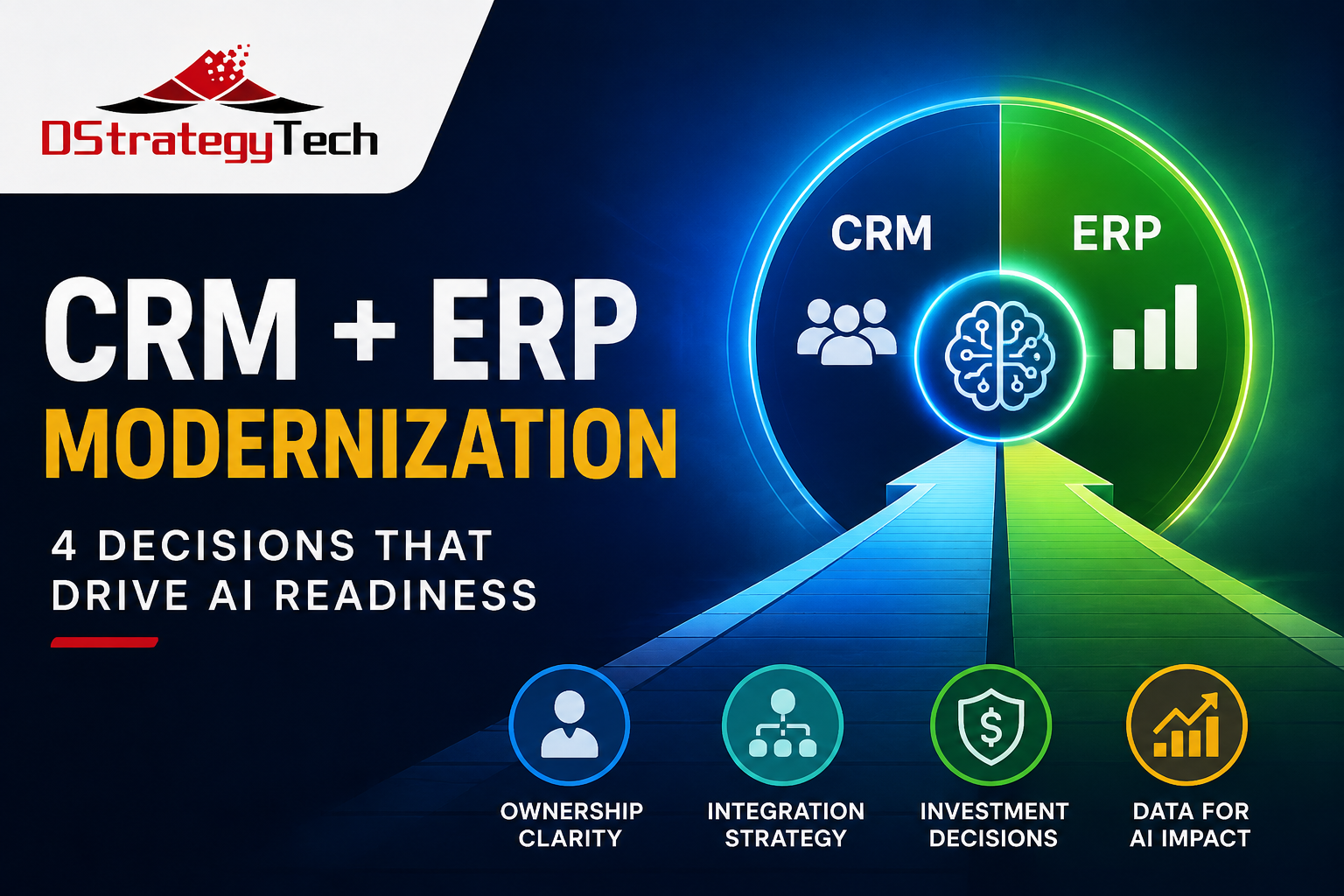
Business Central and CRM modernization for AI readiness

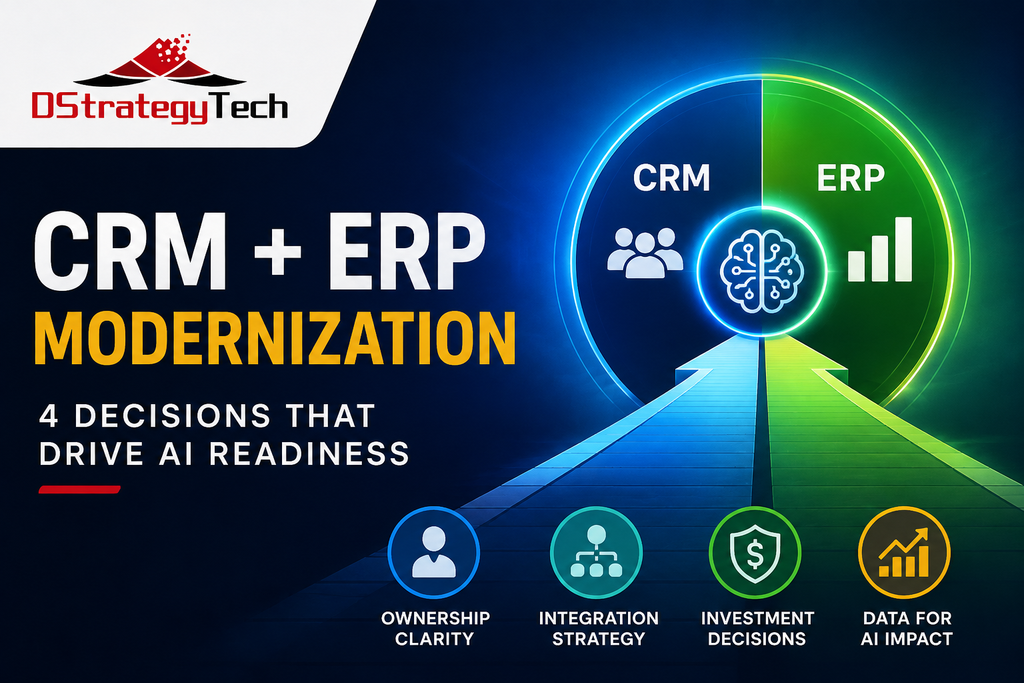
Business Central & CRM Modernization: 4 Decisions That Drive AI Readiness

Modernizing CRM or ERP used to be primarily an application decision.

Which CRM should we use? Should we move our ERP to the cloud? How should sales and finance exchange information?

Those questions still matter. But AI has introduced a more important one:

Will the architecture we build today give AI access to the trusted business data it needs tomorrow?

For organizations using Microsoft Dynamics 365 Business Central alongside Dynamics 365 CRM, HubSpot, or another CRM platform, this distinction matters.

There are really two types of integration involved.

System integration keeps applications synchronized so employees can work efficiently. A customer created in CRM can appear in Business Central. A closed opportunity can initiate an order process. Salespeople can see relevant financial information without switching systems.

Data integration brings information from CRM, Business Central, and other business systems into a common data and analytics foundation where it can be combined, analyzed historically, governed, and eventually used by AI.

You can have excellent system integration and still have a weak foundation for AI.

That is why CRM and Business Central modernization should increasingly be treated as a business data decision, not simply an application migration.

1. Decide Which System Owns the Customer

CRM and ERP systems both contain customer information, but they use that information for different purposes.

CRM typically manages the commercial relationship: prospects, opportunities, activities, pipeline, sales conversations, and service interactions.

Business Central manages the operational and financial relationship: customers, orders, invoices, payments, credit information, and financial history.

Problems begin when nobody clearly decides which system owns which information.

Consider something as simple as an address.

If employees can independently update the same billing or shipping information in CRM and Business Central, which system is correct when the records disagree?

Integration cannot solve an ownership problem that the business has never resolved.

Before designing integrations, establish:

  • which application owns each important data element;
  • when ownership changes during the customer lifecycle;
  • which direction information should flow; and
  • how conflicting information will be handled.

This becomes even more important with AI.

An AI agent operating across CRM and ERP information needs trusted definitions. If two systems provide conflicting customer information, the agent should not be expected to determine which business definition management intended.

Data ownership should be designed before AI is layered on top.

2. Choose CRM Based on the Whole Architecture

For organizations using Business Central, there are several reasonable CRM strategies.

Dynamics 365 CRM

Dynamics 365 can be attractive when an organization wants to standardize more of its business applications on the Microsoft ecosystem.

Business Central, Dynamics 365 applications, Dataverse, Power Platform, Microsoft Fabric, Power BI, and Microsoft Copilot provide multiple options for creating connected business processes and analytics.

The strategic benefit isn’t simply having another Microsoft application.

It’s the opportunity to reduce integration complexity while building a broader Microsoft data and AI architecture.

HubSpot or Another CRM

Moving away from an existing CRM isn’t automatically the right answer.

If marketing and sales teams are productive in HubSpot, Salesforce, or another platform, replacing it solely for architectural consistency can create significant organizational disruption.

Instead, evaluate the real integration requirements.

What information must flow into Business Central?

What ERP information does the sales team need?

How will CRM information reach the analytics platform?

What integrations will require ongoing monitoring and maintenance?

A non-Microsoft CRM can work very well with Business Central. But the integration architecture and its long-term cost should be part of the platform decision from the beginning.

Multiple CRM Platforms

Some organizations intentionally use different applications for marketing, sales, service, or specialized processes.

That can work.

But the boundaries must be deliberate.

Otherwise, the organization gradually creates multiple versions of the customer, duplicated integrations, inconsistent reporting, and a much harder data environment for AI.

3. Evaluate Integration Cost Beyond Implementation

Organizations often compare CRM platforms using software licensing and implementation estimates.

Integration deserves its own calculation.

Depending on the architecture, organizations may use Microsoft capabilities, third-party integration platforms, APIs, Power Platform, Azure services, or custom development to connect applications.

Each approach has a different combination of:

Cost. Flexibility. Maintainability. Monitoring. Vendor dependency. Internal skills required.

One question is particularly useful when evaluating an integration design:

If the person who built this integration leaves tomorrow, can we still operate and support it?

That question often exposes architecture risk faster than a feature comparison.

The same principle applies to AI automation.

A clever integration or agent that only one developer understands can quickly become operational debt.

Modernization should reduce that dependency, not create more of it.

4. Make Sure the Data Reaches Your AI Foundation

This is where CRM modernization and AI readiness intersect.

Imagine a salesperson asks an AI assistant:

“Which customers should I prioritize this week?”

CRM might know:

  • opportunity activity;
  • recent conversations;
  • engagement;
  • pipeline stage; and
  • next actions.

Business Central might know:

  • payment history;
  • outstanding balances;
  • sales history;
  • margins;
  • orders;
  • returns; and
  • fulfillment performance.

Neither system necessarily has the complete answer.

The real opportunity appears when trusted CRM and ERP information can be brought together through a governed data foundation.

For Microsoft-oriented organizations, that foundation might involve technologies such as Microsoft Fabric, Dataverse, Power BI, Power Platform, and appropriate integration services.

Then analytics and AI can work across business processes rather than remaining trapped inside individual applications.

This is why DStrategyTech treats data foundation and integration as a core part of the AI journey—not simply an implementation detail.

What AI Changes About CRM and ERP Integration

Traditional reporting can tolerate some ambiguity.

Someone sees an unexpected number on a dashboard, asks where it came from, and eventually discovers that finance and sales define “active customer” differently.

AI makes that problem more consequential.

An AI assistant can turn inconsistent information directly into a recommendation or action.

Before using CRM and Business Central data for AI, organizations should therefore establish four things:

  • Trusted business definitions. Terms such as customer, active customer, revenue, opportunity, margin, and renewal should have agreed meanings.
  • Cross-system context. AI should have access to the operational information required for the decision it is helping make.
  • Historical information. Forecasting, customer behavior, churn indicators, and other analytical scenarios usually require history rather than only today’s state.
  • Security and governance. Bringing ERP and CRM information together should not mean every user or AI agent receives access to everything.

These aren’t simply technical requirements.

They determine whether employees can trust the resulting AI.

Four Questions Leaders Should Ask Before Modernizing

Before approving the next CRM or Business Central modernization project, ask:

1. Which system owns each important piece of customer information?

2. Are we connecting our systems only for employees, or are we also creating a usable data foundation?

3. What is the three-year cost of maintaining the integrations—not simply building them?

4. If we deployed an AI agent against this environment next quarter, what important information would it be missing?

Those questions can change the architecture before expensive decisions become difficult to reverse.

Modernize for the Business You Are Building

The goal of CRM and ERP modernization should not be simply to reproduce today’s processes on newer software.

It should create a better operational foundation.

That means establishing clear data ownership, connecting applications appropriately, improving the quality and accessibility of business information, and designing the environment so analytics and AI can use that information responsibly.

For many SMBs, the progression will increasingly look like this:

Business Central + CRM → Integration → Trusted Data → Analytics → AI & Agents

The applications still matter.

But increasingly, the value comes from what your organization can do with the data flowing between them.

DStrategyTech helps SMBs modernize Microsoft Dynamics 365 Business Central and CRM environments while building the data and integration foundations required for analytics and AI.

Our Microsoft services include Business Central implementation and optimization, Dynamics 365 CRM, system integration, Microsoft Fabric, Power BI, AI readiness, AI agents, automation, and security.

If you’re evaluating a CRM modernization, Business Central project, or how to prepare your business systems for AI, contact DStrategyTech to discuss your environment and next steps.

Salesforce to Microsoft Dynamics 365 CRM migration with AI, data, analytics, and security

Salesforce to Microsoft D365 CRM: A Decision Framework for Microsoft-Invested Organizations

Most CRM replacement projects are justified on the wrong grounds.

Feature comparisons, screen tours, and vendor scorecards rarely predict whether a migration succeeds. Salesforce is a strong product. If your organization is running it well and your technology estate is genuinely multi-vendor, replacing it is expensive theater.

The question worth asking is narrower: Is your CRM sitting outside the platform where the rest of your business already runs?

For organizations standardized on Microsoft 365, Azure, Power BI, and Dynamics ERP, the answer is increasingly yes—and the cost of that separation compounds as AI, data, and security strategies mature.

Start With the Disqualifiers

This move is probably wrong for you if:

  • Salesforce is deeply embedded with a mature ISV ecosystem you would have to rebuild
  • Your Microsoft footprint is limited to email and Office
  • Your sales operations team has significant Salesforce expertise and no Microsoft skills
  • You are in the middle of another core system replacement
  • The primary motivation is license cost alone

That last point deserves emphasis. Dynamics 365 is not automatically cheaper. Bundled licensing can look favorable on a spreadsheet and then be offset by implementation, integration, data migration, storage, administration, and training. Any migration business case that leads with license savings and stops there is incomplete.

The move is worth evaluating when three conditions hold together: Microsoft is your primary cloud and productivity platform, you need CRM data connected to ERP or operational systems, and you have an AI or analytics agenda that requires governed, unified data.

Four Reasons That Hold Up Under Scrutiny

1. Your sellers already work somewhere else

Sales teams spend their day in Outlook and Teams. When CRM lives outside that surface, adoption becomes an enforcement problem—pipeline reviews turn into data-hygiene meetings, and forecast accuracy degrades because updates happen late or not at all.

Microsoft Dynamics 365 Sales brings customer records, activity, and pipeline closer to the applications sellers already have open.

The Dynamics 365 App for Outlook allows users to view CRM information related to an email or appointment and associate communications with opportunities, accounts, and other records. Dynamics 365 and Microsoft Teams integration supports collaboration around customer records, sales opportunities, meetings, and related activities.

This does not make CRM adoption automatic. It removes one of the most common structural reasons it fails.

The business outcome to measure is not merely “user satisfaction.” It is forecast accuracy and the lag between a customer interaction and its appearance in the system.

2. Customer data stops living in two ecosystems

Your customer is described across CRM, ERP, service, marketing, and finance systems. When CRM sits on a separate platform, connecting those pictures requires integration work that someone has to build, own, govern, support, and pay for indefinitely.

Dynamics 365 stores business information in Microsoft Dataverse—the same foundation used by Power Platform and accessible through Power BI, dataflows, and Microsoft Fabric.

For organizations already running Dynamics 365 Business Central, Finance, or Supply Chain Management, Microsoft provides supported integration paths for common front-office and back-office scenarios.

For example, Microsoft documents the integration of Dynamics 365 Sales and Business Central through Dataverse. Depending on the configuration, organizations can synchronize information such as customers, contacts, products, sales orders, and related business records.

How much of that applies to a particular organization varies. Coverage differs by product, version, deployment model, data structure, and business process. Any process that departs from the standard flow may still require configuration or custom integration.

The advantage is a shorter path from a documented starting point—not the absence of integration work.

A connected data foundation helps leadership answer questions that cross system boundaries:

  • Which opportunities converted into collected revenue?
  • Which customers remain profitable after service costs?
  • Which accounts have unresolved operational or service issues?
  • Where is the sales pipeline actually stalling?
  • Which products and services generate the greatest customer value?

DStrategyTech’s Data and AI services help organizations connect business information through Microsoft Fabric, Power BI, Dataverse, and related Microsoft technologies.

3. AI value depends on the data layer underneath it

Every CRM vendor now demonstrates AI that summarizes accounts and drafts follow-up messages. The demonstrations are broadly similar. The difference appears in production.

Useful AI requires governed data, enforced permissions, approved workflows, monitoring, and human oversight.

Microsoft Copilot, Copilot Studio, Dynamics 365, Dataverse, and Azure AI can operate within an organization’s broader Microsoft identity and data environment. Copilot Studio can use Dataverse tables as knowledge sources, allowing agents to work with approved business data.

This creates an opportunity to design AI agents around existing Entra ID identities, Dataverse security roles, connector permissions, and organizational data-governance policies.

However, what an agent can actually see is a design decision—not an automatic inheritance.

Effective access depends on:

  • How the agent is authored
  • Which authentication method it uses
  • Which connectors are enabled
  • Whether actions execute as the user, an owner, or another identity
  • How Dataverse security roles are assigned
  • How each connected data source enforces permissions
  • Whether sensitive actions require human approval
  • How agent activity is monitored and audited

Agents can be configured to operate with broader access than the requesting user. That possibility must be governed deliberately.

Microsoft provides guidance for securing and governing Copilot Studio projects, including the use of Dataverse security roles for agent-authoring permissions.

If your AI roadmap is serious, the practical question is not which vendor’s assistant writes a better email. It is which platform allows you to govern agent access using the identity, security, and data model your team already operates.

4. One platform can simplify security and administration

Running Salesforce alongside Microsoft 365, Azure, Power Platform, and Microsoft Security can mean maintaining parallel identity configurations, data-loss-prevention policies, audit trails, administrative skills, integration tools, and support relationships.

Consolidation can bring CRM into a broader strategy involving:

  • Microsoft Entra ID
  • Multifactor authentication
  • Conditional Access
  • Dataverse security roles
  • Field-level and record-level security
  • Power Platform data-loss-prevention policies
  • Microsoft Purview
  • Microsoft Defender
  • Microsoft Sentinel
  • Centralized auditing and security monitoring

Worth stating plainly: none of this is automatic.

Dynamics 365 and Power Platform environments require deliberate architecture, security-role design, environment management, auditing, and ongoing governance. Consolidation reduces the number of platforms and control models an organization must operate. It does not eliminate the responsibility to operate them well.

DStrategyTech provides Microsoft cybersecurity services across Microsoft Entra, Defender, Sentinel, identity protection, security monitoring, and governance.

What This Actually Takes

Migrations fail on scope estimation, not technology. The variables that drive cost and timeline include:

  • Customization depth: Standard objects with light configuration generally migrate more cleanly. Heavy Apex development, custom objects, and managed packages do not.
  • Integration count: Every connected system creates a decision: rebuild, replace, redesign, or retire.
  • Data quality: Migration is the moment years of duplicate accounts, incomplete records, and abandoned fields become visible. Budget for remediation—not only movement.
  • Process redesign: Lifting Salesforce processes unchanged into Dynamics 365 wastes much of the potential value and can create an awkward system. Deciding what to redesign is a business exercise, not merely a technical one.
  • Reporting rebuild: Existing reports and dashboards do not transfer automatically. Inventory what is genuinely used before assuming everything must be recreated.
  • Security design: Users, teams, business units, privileged roles, application identities, integrations, and field-level access must be mapped and tested.
  • Change management: This is frequently the most underestimated line item in a CRM migration.

A defensible plan phases these activities. It does not attempt a single cutover across all of them without discovery, testing, validation, and user preparation.

The Assessment

Before committing to a migration, you should have a cost model and a phased plan that you can take to executive leadership or the board.

You should be able to obtain that analysis without first hiring the implementation partner for the complete migration.

DStrategyTech delivers a structured Salesforce-to-Dynamics 365 assessment covering:

  • Salesforce objects, fields, customizations, and automations
  • Integration and dependency mapping
  • Data-quality analysis and migration-complexity rating
  • Reporting and analytics inventory
  • Security, compliance, and identity alignment
  • Copilot and AI readiness
  • Total cost of ownership, including implementation and ongoing operations
  • A phased migration plan with a risk register and cutover strategy

Deliverable: A written migration roadmap and cost model that the customer owns—including a recommendation not to migrate if the evidence does not support the move.

DStrategyTech is a Michigan-based Microsoft Partner led by a former Microsoft MVP. We help organizations connect Dynamics 365, Power Platform, Microsoft data technologies, AI, and security around measurable business outcomes.

Considering a move from Salesforce to Microsoft Dynamics 365? Contact DStrategyTech to scope a Salesforce-to-Dynamics 365 assessment.