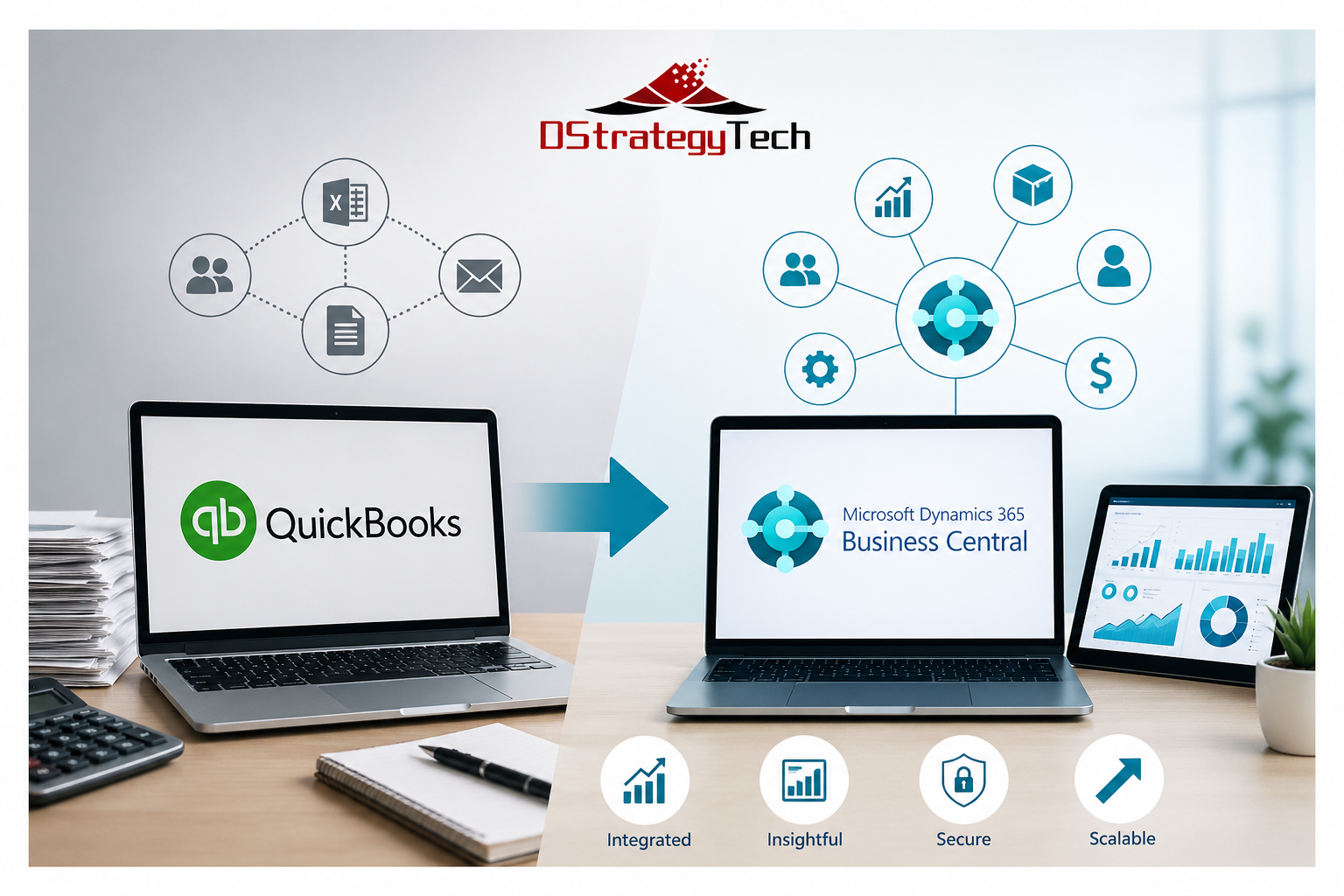
Business Central: Going Beyond QuickBooks
Business Central: Going Beyond QuickBooks
For many small and mid-sized businesses, QuickBooks is where financial management begins. It is simple, familiar, and effective in the early stages of growth. Teams can manage invoices, track expenses, and close books without much complexity.
As the business grows, however, the same simplicity can start to create limitations. More processes are introduced, more data needs to be managed, and more people depend on accurate and timely information. At this stage, many organizations begin to look beyond QuickBooks.
Where QuickBooks Starts to Fall Short
QuickBooks is designed primarily for accounting. As operations expand, new requirements begin to surface. Businesses start managing multiple entities, handling inventory, tracking projects, and introducing approval processes.
To support these needs, teams often rely on spreadsheets and disconnected tools. Data moves between systems instead of staying in one place, which creates delays and inconsistencies.
Over time, this leads to limited visibility, slower reporting cycles, and increased dependency on Excel. The system continues to function, but it no longer supports how the business operates.
A More Connected Foundation with Business Central
Microsoft Dynamics 365 Business Central brings financials and operations together into a single platform. Instead of extending QuickBooks with multiple tools, Business Central connects sales, purchasing, inventory, and finance through a unified data model.
For organizations evaluating the transition, Microsoft provides detailed guidance on moving from QuickBooks to Business Central, including data structure, setup, and considerations. View Microsoft guidance on QuickBooks to Business Central .
This creates a more structured environment where processes are standardized and workflows are built into the system. As a result, businesses reduce manual reconciliation and improve consistency across departments.
Key Capabilities of Business Central
Business Central supports financial management across multiple entities, integrates operational workflows, and provides built-in controls for approvals and compliance. This allows organizations to align their system with how they actually operate.
Improving Reporting and Visibility with Power BI
Even after implementing a new system, many organizations still rely on spreadsheets for reporting. This is where Microsoft Power BI becomes important.
Power BI enables centralized dashboards and real-time reporting. Instead of waiting for reports to be prepared, teams can monitor financial and operational performance as it happens.
Benefits of Power BI Integration
With Power BI, organizations gain consistent metrics, improved visibility across functions, and faster access to insights. This supports better decision-making across leadership and operational teams.
Preparing for AI Requires Structured Data
As businesses begin adopting automation and AI, data quality becomes critical. AI tools rely on structured and consistent data to deliver meaningful results.
Business Central provides a foundation for this by organizing data and standardizing processes. This enables practical use cases such as forecasting, automation, and intelligent recommendations.
Security and Control in a Connected System
As systems become more integrated, security becomes a core requirement. Business Central operates within the Microsoft ecosystem and works with tools such as Microsoft Entra and Microsoft Defender.
This provides identity-based access control, role-based permissions, and data protection. Organizations gain better control over who can access information and how data is used across the system.
What Going Beyond QuickBooks Really Means
Going beyond QuickBooks is not simply about changing systems. It reflects a shift in business needs.
Common indicators include heavy reliance on Excel, fragmented data across systems, slow month-end processes, and limited visibility across teams. At this stage, continuing with workarounds becomes less effective than adopting an integrated platform.
About DStrategyTech
DStrategyTech is a Microsoft partner focused on Business Central, data, and automation. The approach centers on helping organizations improve visibility, streamline operations, and build a scalable foundation using Microsoft technologies.
Final Thoughts
QuickBooks continues to serve an important role for early-stage businesses. However, as operations grow, the need expands beyond accounting.
Business Central provides a more structured and scalable foundation for managing operations, improving visibility, and supporting future capabilities such as automation and AI.
Going beyond QuickBooks is not a technical upgrade. It is a step toward running the business with greater clarity, consistency, and control.
Learn More
If your organization is experiencing these challenges, it may be time to evaluate the next step. Contact DStrategyTech to explore how Business Central, Power BI, and automation can support your business.


Related Posts